

Business Operation · 2025
In this section22 topics
- Corporate Information4 items
- Dividend Policy2 items
- Major Shareholders1 item
- Business Strategies Overview5 items
- Material Changes & Developments1 item
- Use of Proceeds from Securities Offerings1 item
- Commitments Made in the Registration Statement1 item
- Group Operating-Structure Policy1 item
- Companies Where the Company Holds ≥10%1 item
- Shareholders with Potential Conflict of Interest1 item
- Relationships Among Major Shareholders1 item
- Shareholders' Agreement1 item
- Shareholding Diagram (Group Structure)2 items
- Income Structure3 items
- Product / Service Characteristics2 items
- Research & Development6 items
- Assets Used in the Business4 items
- Marketing Policy & Competition3 items
- Procurement of Products & Services6 items
- Projects Under Construction1 item
- Debentures & Bills of Exchange1 item
- Convertible Securities1 item
Corporate Information
Company Name
THAI AUTO TOOLS AND DIE PUBLIC COMPANY LIMITED
Telephone
0-2598-3876-9
Website
www.thaiautotools.co.th
ir@thaiautotools.co.th
Dividend Policy
Dividend Policy
Thai Auto Tools and Die Public Company Limited (the “Company”) has a policy to pay dividends at a rate of not less than 40 percent of net profit after corporate income tax according to the separate financial statements and after deducting all types of reserves as specified by law and the Company, and such dividend payments will not significantly affect the Company’s normal operations. The dividend payments will be made according to the number of shares,
in equal amounts per share.
Once the Board of Directors’ meeting has passed a resolution to approve a dividend payment, it must be submitted for approval to the shareholders’ meeting, except for interim dividend payments, which the Board of Directors may approve from time to time when it sees that the Company has sufficient profit to do so, and such interim dividend payments must be reported to the shareholders’ meeting for acknowledgment at the next shareholders’ meeting.
However, such dividend payments are subject to changes depending on the Company’s performance and financial position, business expansion plan, liquidity of the Company, other necessities, and appropriate circumstances in the future, along with other factors related to the Company’s management as deemed appropriate by the Company’s Board of Directors and/or the shareholders’ meeting, and such actions must be in the best interest of the shareholders.
Historical Dividend Payments
| This Year | Last Year | 2 Years Ago | Metric | Description |
|---|---|---|---|---|
| 0.19 | 0.21 | 0.16 | Net profit per share (Baht : Share) | Net profit per share (baht : share) |
| 0.07 | 0.07 | 0.15 | Dividend per share (Baht : Share) | Dividend per share (baht : share) |
| 0 | 0 | 0 | Dividend stock ratio (Number of original shares: dividend shares) | Ratio of stock dividend payment (existing share : stock dividend) |
| 0 | 0 | 0 | Dividend share value per share (Baht : Share) | Value of stock dividend per share (baht : share) |
| 0.07 | 0.07 | 0.15 | Total dividend payment value (Baht : Share) | Total dividend payment (baht : share) |
| 77.72 | 102.35 | 136.52 | Dividend payout ratio to net profit (%) | Dividend payout ratio compared to net profit (%) |
Business Strategies Overview
Chairman's Message
Message from the Chairman of the Board
Dear Shareholders and Investors
In 2025 is another challenging year for the automotive industry. From the increasingly severe tariff measures between the United States and China since the beginning of the year to the announcements of various import tariffs for many countries in Asia, Thailand has become affected by these tax measures. Concurrently, technological changes are rapidly taking place in business, causing extremely intense competition within the industry. For the automotive industry of Thailand, it is clear that the establishment of electric vehicle production bases by many Chinese brands partially contributing to the replacement of some vehicle imports under the EV3.0 measure, leading to a positive growth trend for the production of electric vehicles for export and domestic distribution. However, the measure to import parts from China remains a major challenge to automotive parts manufacturers in Thailand.
For Thai Auto Tools Group, all members of the Board of Directors and Executives are closely monitoring situations affecting business operations in order to make strategic adjustments to remain competitive. In the past year, along with economic factors and industrial upheavals, environmentally-friendly business operation is another area that Thai Auto Tools Group has given as a top priority. According to that, the Company has been implementing solar rooftop projects since 2024, covering all three areas in Pathum Thani and Chon Buri. Our effort aims to promote the usage of clean energy within the organization by implementing measures consistently with the national greenhouse gas emissions reduction targets.
Last but not least, on behalf of the Board of Directors, I would like to thank for all shareholders, business parters, employees and stakeholders for having the Company unwavering. Every member of the Board of Directors and all executives remain committed to operating business responsibly and transparently in order to step forward together into a secure and sustainable future.
Dr. Damri Sukhotanang,
Chairman of the Board of Directors
Message from the CEO
Dear Shareholders and Stakeholders
The automotive industry in 2025 remains challenged by economic situations that have led to major impacts on both vehicle production and sales in the country as well as exports abroad. At the same time, Thai Auto Tools and Die Public Company Limited (“TATG”) and the subsidiaries under Thai Auto Tools and Die continue to emphasize technological and personnel developments in order to support potential changes. In 2025, as a result of Thailand’s EV3.0 measure, Chinese electric vehicle production plants began to manufacture electric vehicles to compensate for export numbers. These manufacturers seek reliable partners in the country, and Thai Auto Tools Group, having recognized this growth, has presented our capabilities to the electric vehicle manufacturers investing in Thailand in order to expand our future customer base.
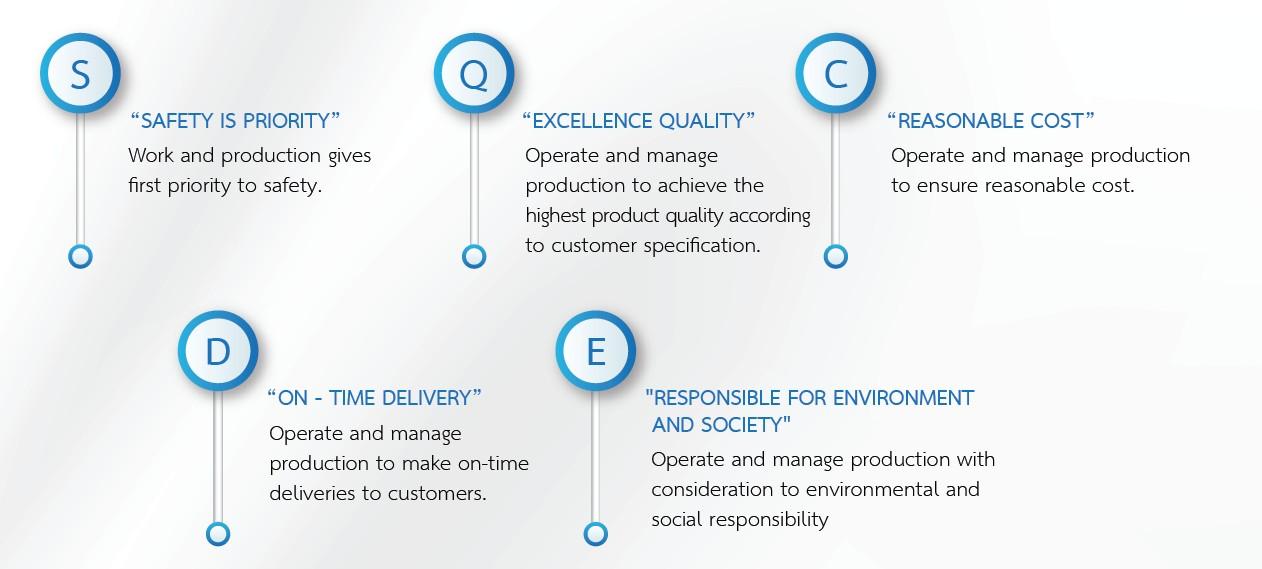
The Company’s business operation continues to adhere to the policy of prioritizing safety, quality, timely deliveries and appropriate pricing while giving consideration to environmental impacts. Presently, it is apparent that customers, trade partners and stakeholders value business sustainability. As a result, Thai Auto Tools Group is emphasizing three dimensions of business operations which are Environment, Social and Governance, while also continuously implementing ESG projects. In 2025, the Group has set a long-term greenhouse gas emissions reduction targets to achieve carbon neutrality by year 2030 and then achieve net zero carbon emissions by year 2065 in line with national targets. Furthermore, we have declared our intention to enter the Thai Private Sector’s Collective Action Against Corruption (CAC) to communicate to all stakeholders of the Group’s determination to firmly commit to social responsibility and all stakeholders through integrity, honesty and fairness without seeking personal benefits that could lead to conflicts of interest with Thai Auto Tools Group.
Last but not least, on behalf of all executives, I would like to thank for all employees, business partners, shareholders and stakeholders in order to supporting and driving the Company forward. We committed to continue operate the business responsibly and transparently to achieve sustainable growth.
Dr. Payung Sakdasawit
Chief Executive Officer
Vision
To be a leader in designing and manufacturing high-quality metal dies, jigs and automotive parts in Asia that is recognized by customers internationally through use of advance technology and qualified employees.
Objectives
The Company is committed to enhancing the quality of personnel, technology and the production base of metal dies, checking fixtures and assembly jigs, and the automotive parts production base to meet international quality standards comparable to Japanese manufacturers to build customer confidence and satisfaction in quality, cost and timely delivery.
Goals
To raise confidence and achieve maximum customer satisfaction, the Company operates business on the basis of governance and supports the strict compliance of the Company’s personnel and the supply chain to the S, Q, C, D, E policy as follows:
Business Strategies
Business strategy
In order to create a difference in products and services and achieve maximum customer satisfaction, the Company operates a one-stop services business, starting from the design and manufacturing of metal dies, checking fixtures, and assembly jigs, to the manufacturing of automotive press parts, including maintenance services and EDP coating to meet customer expectations and goals in terms of quality, cost and on-time delivery.
In order to create maximum confidence and satisfaction for customers at the international level, the Company has enhanced personnel skill development to be of the same quality as in Japan and has implemented the just-in-time production system that is accepted and used by leading Japanese car brands in the organization and the manufacturing network. The company has also invested in the introduction of highly efficient modern technology, software and machinery into the design and manufacturing process to support future parts design and increase the Company's competitiveness.
Human resource strategy
The Company emphasizes continuous personnel development, along with the development of modern and high-efficiency manufacturing process technologies, with particular focus placed on developing the Company into a learning organization with an international management system that emphasizes personnel development, which is an important factor that leads to the success and strength of the business. In addition, the Company also promotes a work culture called training for the trainer or a system in which senior employees teach junior employees. This ensures that new employees who join the team are shared knowledge and developed in their skills to achieve expertise to be able to rapidly support various work tasks.
Material Changes & Developments
Material Changes & Developments
| Year | Description |
|---|---|
| 1,993 |
|
| 2,004 |
|
| 2,010 |
|
| 2,011 |
|
| 2,012 |
|
| 2,013 |
|
| 2,017 |
|
| 2,018 |
|
| 2,019 |
|
| 2,020 |
|
| 2,021 |
|
| 2,023 |
|
| 2,024 |
|
| 2,025 |
|
Use of Proceeds from Securities Offerings
Is There Money Raised from a Securities Offering Still to Report On?
No
Commitments Made in the Registration Statement
Are There Commitments or Conditions from an Offering or Listing?
No
Group Operating-Structure Policy
Description
In supervising the operations of its subsidiaries and associated companies (if there are associated companies in the future), Thai Auto Tools and Die Public Company Limited (" The Company ") has established a policy for supervising the operations of its subsidiaries and associated companies. The objective is to define both direct and indirect measures and mechanisms to enable the Company to supervise and manage the affairs of its subsidiaries and associated companies, as well as to monitor and ensure that subsidiaries and associated companies comply with the established measures and mechanisms and adhere to the Company's policies, including the Public Company Limited Act, the Civil and Commercial Code, the Securities and Exchange Act, and other relevant laws, as well as announcements, regulations, and criteria of the Capital Market Supervisory Board, the Securities and Exchange Commission, and the Stock Exchange of Thailand. This is to protect the Company's investment interests in the aforementioned subsidiaries and associated companies, with details as follows:
The Company will appoint individuals representing the Company to serve as directors in subsidiaries and/or associated companies in proportion to the Company's shareholding, to supervise and ensure that subsidiaries and/or associated companies operate in compliance with laws, good corporate governance policies, and other policies of the Company. The appointment of the Company's representatives as directors in each subsidiary and associated company must be considered and approved by the Company's Board of Directors, taking into account the qualifications and suitability of the individuals to be appointed as the Company's representatives in various relevant aspects.
The board of directors and management of each subsidiary will have significant duties, powers, and responsibilities under relevant laws, such as disclosing information regarding their financial position and operating results to the Company within the specified timeframe. This includes applying relevant laws, as well as announcements, regulations, and criteria of the Capital Market Supervisory Board, the Securities and Exchange Commission, and the Stock Exchange of Thailand by analogy. It also includes disclosing and submitting information on their own interests and those of related persons to the Company's Board of Directors, informing them of relationships and transactions with the Company and/or its subsidiaries that may give rise to conflicts of interest, and avoiding transactions that may create conflicts of interest.
If a subsidiary enters into any transaction or operation that is significant or affects the Company's financial position and operating results, or falls under the acquisition or disposition of assets as per the announcement on acquisition or disposition of assets, or a connected transaction as per the announcement on connected transactions, which would require the Company to seek approval for the transaction from the Board of Directors' meeting and/or the shareholders' meeting and/or relevant legal authorities before entering into the transaction, the subsidiary may only enter into such a transaction or operation after receiving approval from the Company's Board of Directors' meeting and/or the shareholders' meeting and/or relevant legal authorities (as the case may be).
Furthermore, if a subsidiary enters into a transaction or an event occurs that obligates the Company to disclose information to the Stock Exchange of Thailand in accordance with the criteria specified in relevant announcements, the directors of the subsidiary who represent the Company are obliged to immediately notify the Company's management upon learning that the subsidiary plans to enter into such a transaction or that such an event has occurred.
The Company will establish plans and take necessary actions to ensure that subsidiaries disclose information regarding their operating results and financial position to the Company within the specified timeframe. The Company will also take necessary actions and monitor that subsidiaries have adequate and appropriate disclosure systems and internal control systems for their business operations.
The Company's directors, who serve as representatives of the Company in its subsidiaries, will monitor and take necessary actions to ensure that important policies and plans related to the subsidiaries' business operations are regularly established, reviewed, and updated to be current and appropriate for the subsidiaries' business conditions.
The Company's directors, who serve as representatives of the Company in its subsidiaries, will consider, monitor, and provide necessary advice to the subsidiaries, as well as ensure the establishment of appropriate and sufficiently robust internal control systems to prevent potential fraud against the Company and/or its subsidiaries, and to ensure clear, efficient, and effective operational systems for the subsidiaries' business operations.
Significant operations of subsidiaries, such as the appointment or nomination of individuals as directors in subsidiaries, the purchase or sale of shares, businesses, or material assets, the increase or decrease of a subsidiary's capital, the merger or dissolution of a subsidiary, and the approval of a subsidiary's annual budget, etc., require that the directors of the subsidiary who represent the Company must obtain approval from the Company's Board of Directors before casting their votes at the subsidiary's board meeting.
Companies Where the Company Holds ≥10%
Companies (≥10% Holding)
| Company Name | Address | Province | Zip Code | Telephone | Fax | Business Type | Security Type | Shares | Paid-up Shares |
|---|---|---|---|---|---|---|---|---|---|
| THAI AUTO TOOLS (PATHUMTHANI) COMPANY LIMITED (TATP) | No. 45/6 and 45/9, Moo No. 11, Khu Bang Luang Sub-district, Lat Lum Kaeo District, | Pathum Thani | 12140 | 02-598-3876-9 | Design and manufacture of metal molds, inspection jigs, and assembly jigs | Common shares | 3,000,000 | 3,000,000 | |
| THAI AUTO TOOLS (CHONBURI) COMPANY LIMITED (TATC) | No. 99/107, Moo No. 1, Nong Bon Daeng Sub-district, Ban Bueng District, | Chonburi | 20170 | 038-159-837-9 | 038-159-850 | Manufacture of automotive brake booster covers and electro deposition paint (EDP) coating. | Common shares | 5,000,000 | 5,000,000 |
| THAI AUTO TOOLS (EASTERN) COMPANY LIMITED (TATE) | No. 123, Moo No. 1, Nong Bon Daeng Sub-district, Ban Bueng District, | Chonburi | 20170 | 038-110-863-5 | 038-110-866 | Automotive parts manufacturing with emphasis on high-volume automotive parts manufacturing. | Common shares | 30,000,000 | 30,000,000 |
Income Structure
Product / Service Income
| Category | Description | This Year | This Year % | Last Year | Last Year % | 2 Years Ago | 2 Years Ago % |
|---|---|---|---|---|---|---|---|
| Total revenue from operations | Total revenue from operations | 2,610,435.76 | 100 | 2,701,582.01 | 100 | 3,002,912.3 | 100 |
| Metal Stamping Automotive Parts Manufacturing Business | 2,328,154.87 | 89.19 | 2,388,646.97 | 88.42 | 2,808,089.97 | 93.51 | |
| Business of designing and manufacturing tools for the automotive industry | 281,596.26 | 10.79 | 312,231.43 | 11.56 | 193,160.62 | 6.43 | |
| Other Income | 684.63 | 0.03 | 703.61 | 0.03 | 1,661.71 | 0.06 | |
| Other | Other | 0 | 0 | 0 | 0 | 0 | 0 |
Export Income
| Category | Description | This Year | This Year % | Last Year | Last Year % | 2 Years Ago | 2 Years Ago % |
|---|---|---|---|---|---|---|---|
| Total revenue | Total revenue from operations | 2,610,435.76 | 100 | 2,701,582.01 | 100 | 3,002,912.3 | 100 |
| Domestic | Domestic | 2,610,435.76 | 100 | 2,701,582.01 | 100 | 3,002,912.3 | 100 |
| International | International | 0 | 0 | 0 | 0 | 0 | 0 |
Other Income
| Operating Other Income | Non-Operating Other Income | Share of Profit |
|---|---|---|
| 1710 · As of year: 0.0 · Description: Total other income · As of yesteryear: 0.0 · As of year before yesteryear: 0.0 · 1711 · As of year: 0.0 · Description: Other income from operations · As of yesteryear: 0.0 · As of year before yesteryear: 0.0 | 1712 · As of year: 0.0 · Description: Other income not from operations · As of yesteryear: 0.0 · As of year before yesteryear: 0.0 | 1713 · As of year: 0.0 · Description: Share of profit · As of yesteryear: 0.0 · As of year before yesteryear: 0.0 |
Product / Service Characteristics
Business Type
3114
Business Groups
| Business Group | Description | ||||||||||||||||||||||||||||||||||||||||||||||||||||||||||||||||||||||||||||
|---|---|---|---|---|---|---|---|---|---|---|---|---|---|---|---|---|---|---|---|---|---|---|---|---|---|---|---|---|---|---|---|---|---|---|---|---|---|---|---|---|---|---|---|---|---|---|---|---|---|---|---|---|---|---|---|---|---|---|---|---|---|---|---|---|---|---|---|---|---|---|---|---|---|---|---|---|---|
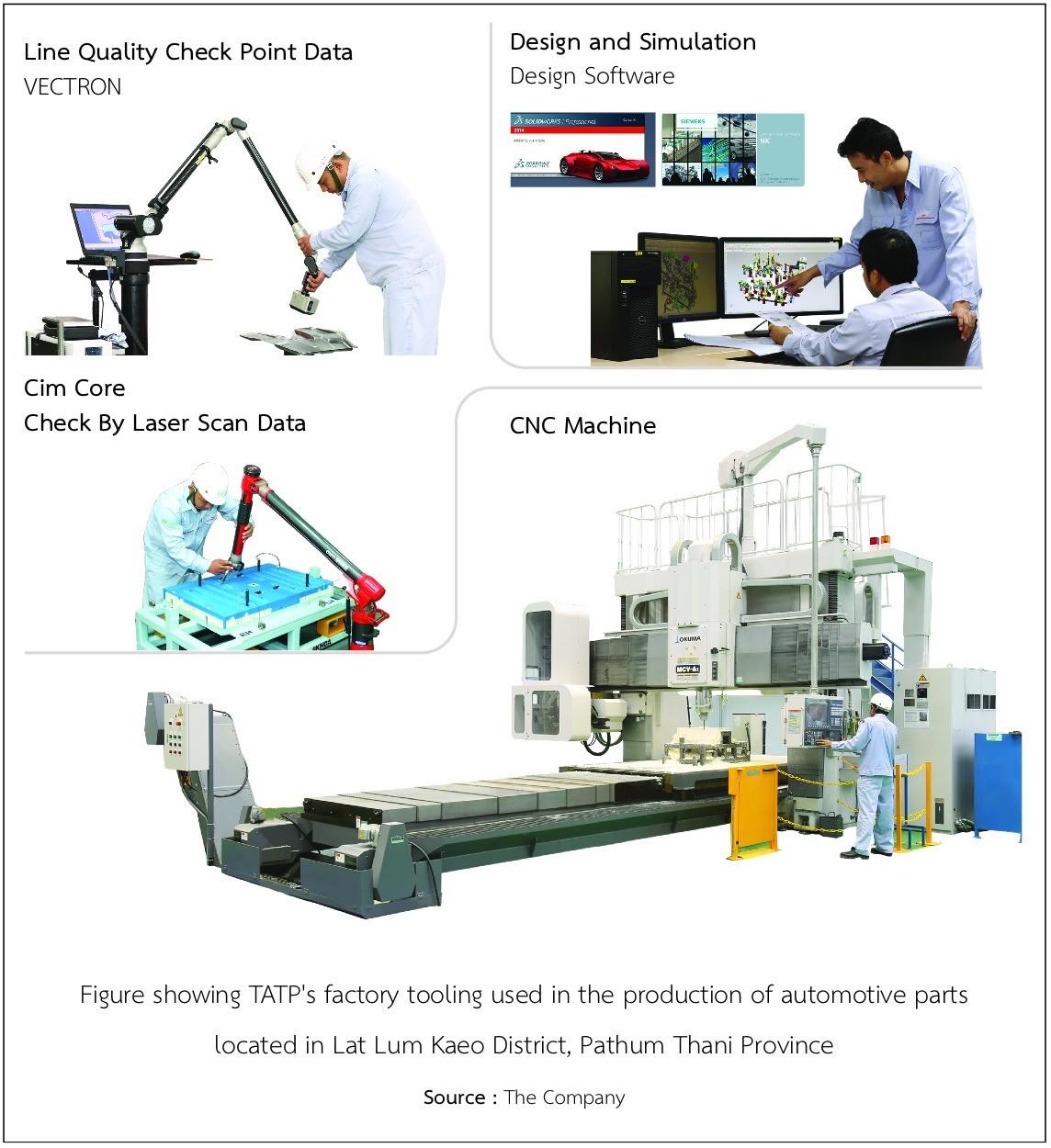
| (1) Design and manufacturing of tools for the automotive industry ("Tooling") | Consists of 3 main product types: 1. Metal Dies 2. Checking Fixtures 3. Assembly Jigs The aforementioned products and services are under TATP's operations, with details for each product as follows: 1.1 Metal Dies Metal dies are a crucial part of automotive component production. Every car consists of metal parts that must be formed using metal dies, and all parts used assembled must meet the highest standards. Through extensive experience and accumulated knowledge, the group of companies possesses qualified personnel with expertise and technology transferred from Japanese component manufacturers. Furthermore, the group has invested in high-performance design software and machinery technology, which has earned TATP a reputation and recognition from customers for designing and manufacturing high-quality metal dies that meet standards comparable to Japanese manufacturers. The company also prioritizes the modernity of tools and equipment that support tool production. The company has invested in implementing 3D computer software systems for die design and automotive component forming simulation, including:
Throughout the production process, there is close collaboration with customers and the highest level of quality control inspection under TATP's operations, which include a team of highly skilled engineers and technicians. This has earned the company the trust of OEM Supplier Tier 1 customers within the automotive industry, car manufacturers, and other industries, as well as Car Brand customers. The business of designing and manufacturing metal dies and fixtures is a crucial component that builds strength and serves as a key selling point, leading customers to trust and choose the group of companies as a parts manufacturer. This is because it addresses speed of production, quality, and cost. Most customers who order dies from TATP also contract the group of companies to produce automotive parts for them after the metal die design and manufacturing work is completed according to specifications. Under systematic operating standards, extensive experience, in-depth knowledge, and the installation of high-performance machinery, customers can be confident in the quality, accuracy, precision, and speed. From designing the process sheet, determining the size of the die (Tons Press), which will involve estimating the total number of workpieces from the start to the end of production for that car model, and defining the type of die, there will be close communication and collaboration with customers. Meanwhile, in the die design process, investment has been made in modern drafting software, utilizing high-precision 3D processing (CAD), and processing the design of die components using stamping simulation software, which is a highly efficient program, providing results to accurately confirm subsequent steps. TATP's factory is equipped with high-performance CNC Machining Centers, identical to those used in leading manufacturing plants in Japan. Customers can therefore be confident in the quality of die manufacturing, ensuring that the structure and machining of metal dies adhere accurately and precisely to the design. Meanwhile, the assembly, fine-tuning, and production simulation stages are under the control and operation of highly skilled engineers and technicians. The workflow for designing and manufacturing metal dies can be summarized as follows: 1) Preparation and design phase. This phase primarily uses 3D computer-aided design (CAD) software to design and create models for analyzing the functionality of metal dies, with the following steps: 1.1 TATP receives technical information, including die characteristics and workpiece details, according to customer requirements. 1.2 Design metal dies using CAD software 1.3 Foam machining for cast iron structure (Full Mold Casting) 2) Production phase. This phase relies on the expertise and skill of engineers and technicians in turning, milling, and surfacing metal die components using CNC Milling, CNC Wire Cut, and Fitting and Finishing Dies, with the following steps: 2.1 Casting for die body structure 2.2 CNC machining for milling metal dies and manufacturing according to the model 2.3 Dies Assembly 2.4 Fitting and Finishing Dies 3) Quality inspection by trial stamping of actual parts using a Tryout Press Machine, including testing the consistency of metal die operation. 4) Take the completed and ready-to-use metal dies to stamp workpieces at TAT TATETATC's factory or the customer's factory, and deliver the finished work to the customer. Comparison table of maximum production capacity and actual production capacity utilization for TATP's metal die design and manufacturing in 2023-2025
Source: The Company Note:
In line with the company's policy to produce quality products, deliver on time, and at reasonable prices, as well as the metal die design and manufacturing process, the engineering department emphasizes close collaboration with customers to ensure that the design and manufacturing of metal dies meet technical specifications and comply with customer details and requirements. Currently, TATP undertakes the design and manufacturing of 3 types of metal dies:
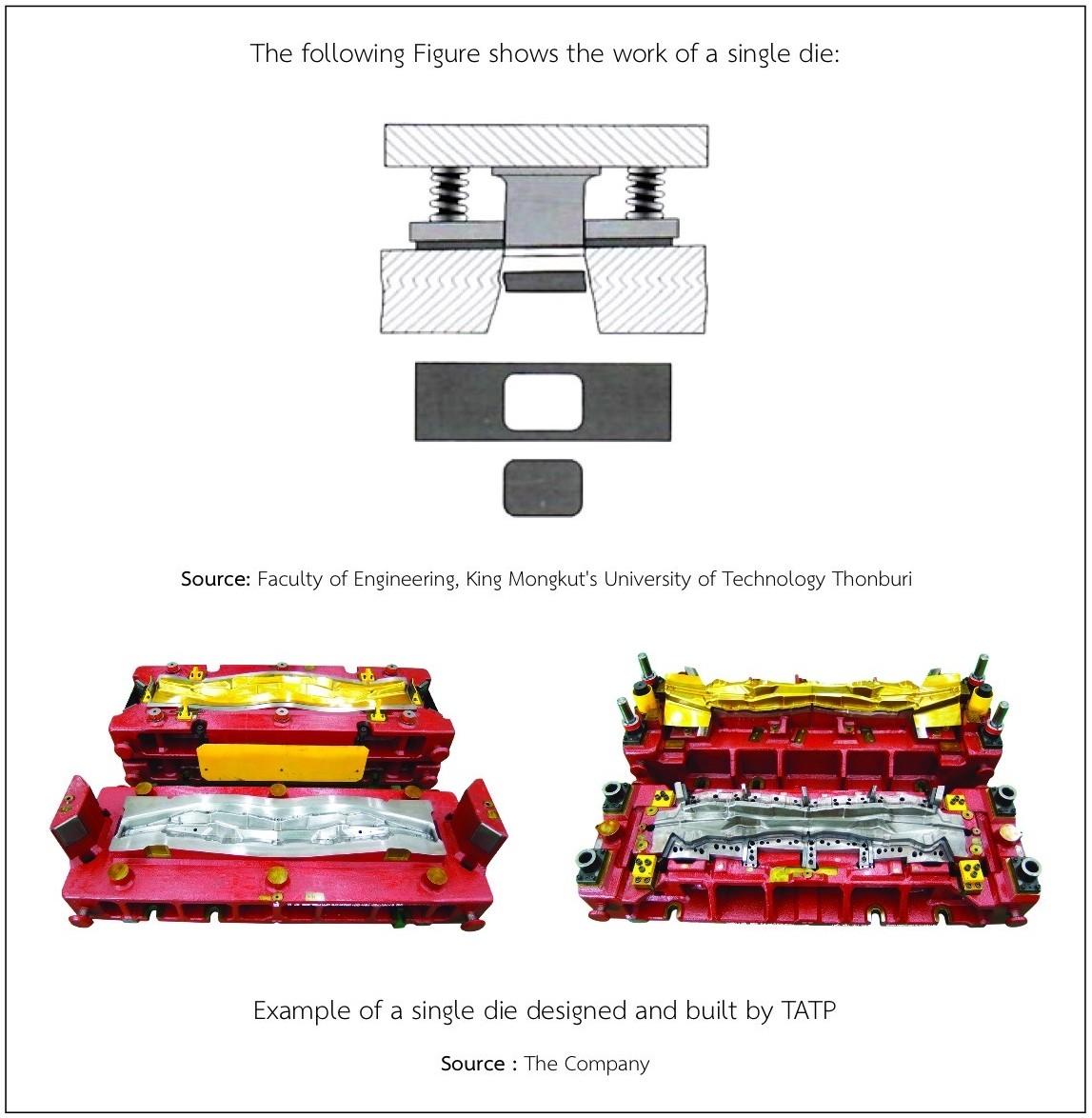
The details of each type of metal die are as follows: 1) Single Die These are metal dies that works with a simple design that performs only a single type of work, which makes it easy to set the manufacturing layout. Single dies involve 1 type of work per station, such as a cutting die, a punching die, a folding die. In determining the production line of the Group, many sets of this type of die are used for the most part to create 1 workpiece, and the number of dies used depends on the complexity of each workpiece because this die has to undergo many steps during the course of production. Accordingly, the production line will consist of many sets of single dies with each set performing only 1 work step as shown in the example image.
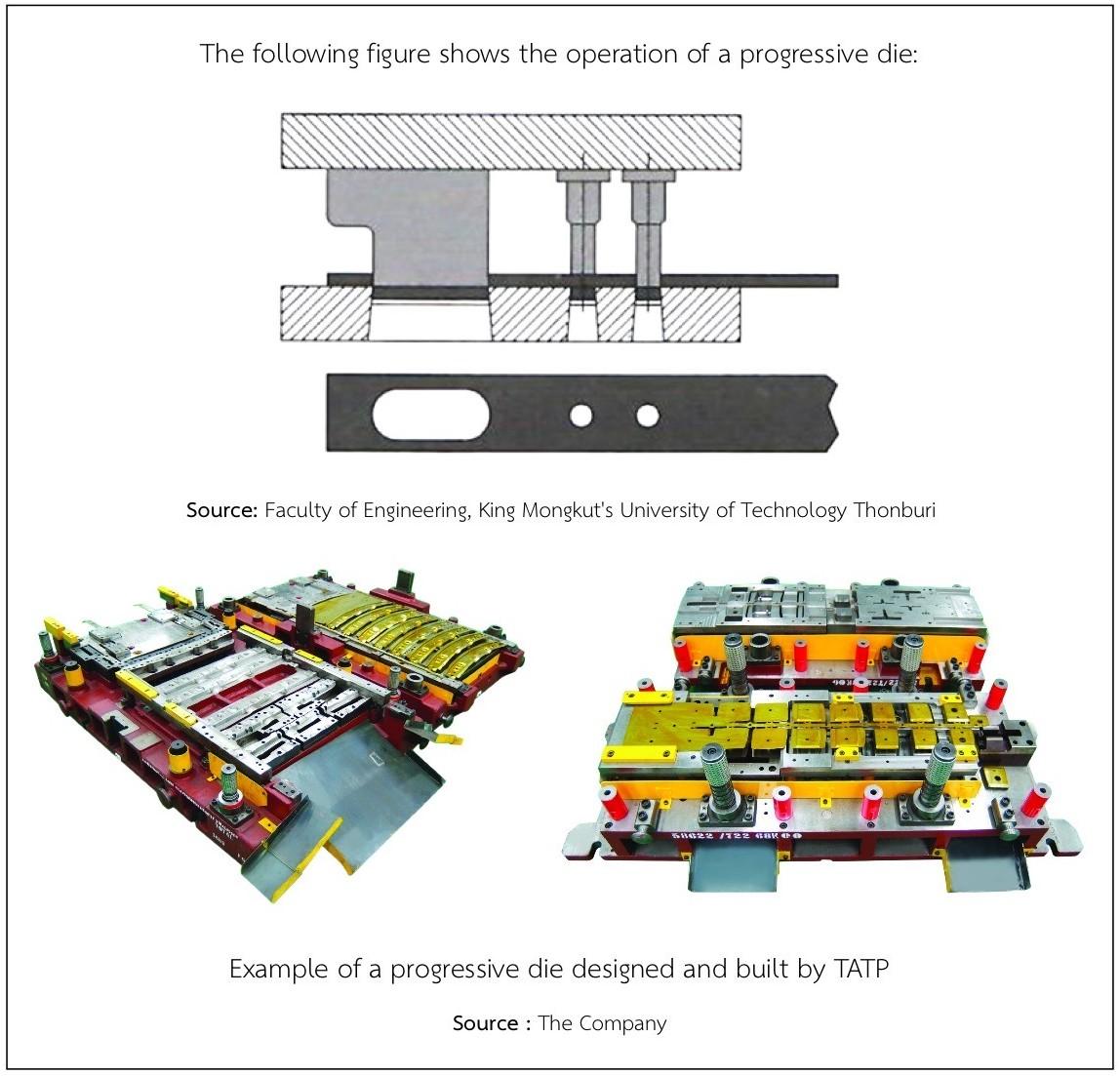
2) Progressive Die This is a set of metal dies with more complex operations than single dies, capable of producing workpieces through multiple steps until the process is completed within a single die set. Raw materials are fed into the machine and undergo several operations, such as punching holes, trimming edges, stamping, bending, and cutting (depending on the complexity of the workpiece) until the desired shape is achieved. The design and manufacturing of progressive dies involve designing the die to have more than one working station integrated into a single die set, with each working station aligned in sequence, thus requiring high expertise in producing this type of die. The process of stamping parts with progressive dies is relatively expensive but popular in the automotive parts manufacturing industry because it can support high-volume manufacturing, thereby helping to reduce costs related to setting up production lines, labor, and machinery. In this type of die stamping process, workpieces can be fed manually or using a feed coil, where a steel sheet is fed into the first die step, which has a stopper to define the starting point, and then stamped to punch holes. After punching, the feed coil moves the workpiece to other stations, using a pilot to determine the position. The workpiece is fed continuously until it reaches the final station, where the sheet is cut to release the finished part. Once the part is released, the feed sheet is stopped at the designated position, and then the next step begins, repeating this cycle.
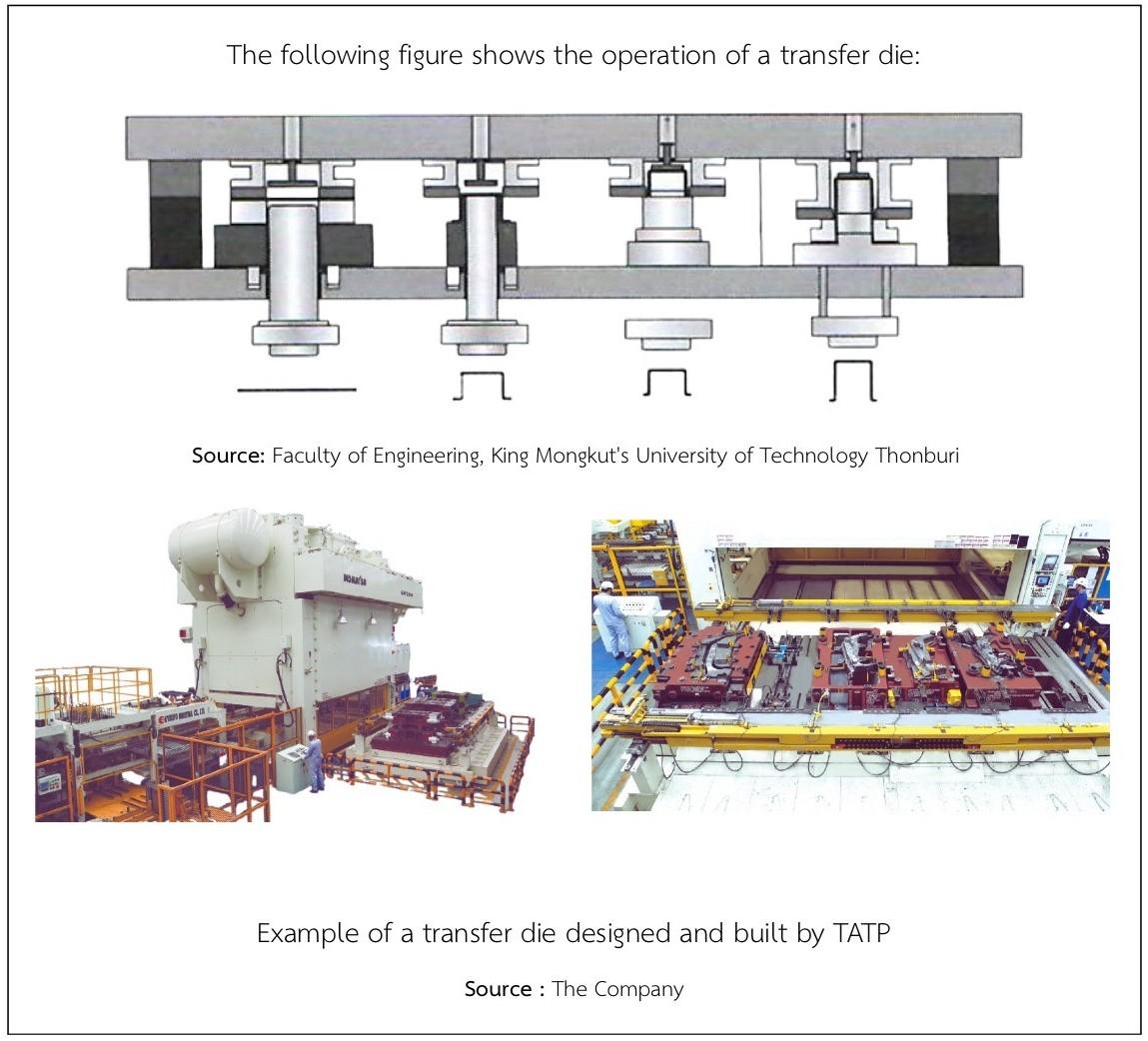
3) Transfer Die This is a set of dies with more than 1 working station, used with large, high-power machinery. The operation of an automatic transfer die begins with placing a steel sheet into a feeding tray, and a robotic arm picks up the steel sheet from the tray and places it into the first die set for stamping. Then, the robotic arm picks up the workpiece from the first die set and places it into the second die set for stamping in the next step, where the workpiece is fed and stamping step by step until passing through the final die set, resulting in a finished workpiece from the production process. The design and manufacturing of automatic transfer dies are more complex than single dies, which is another testament to the advanced quality, capability, and expertise of the engineering and technical team. This type of die is used in conjunction with workpiece conveying equipment such as robotic arms, conveyor belts, or other gripping devices to transfer workpieces to subsequent stations. This results in relatively high design and manufacturing costs, making it suitable for high-volume manufacturing and the production of large components requiring high production speed
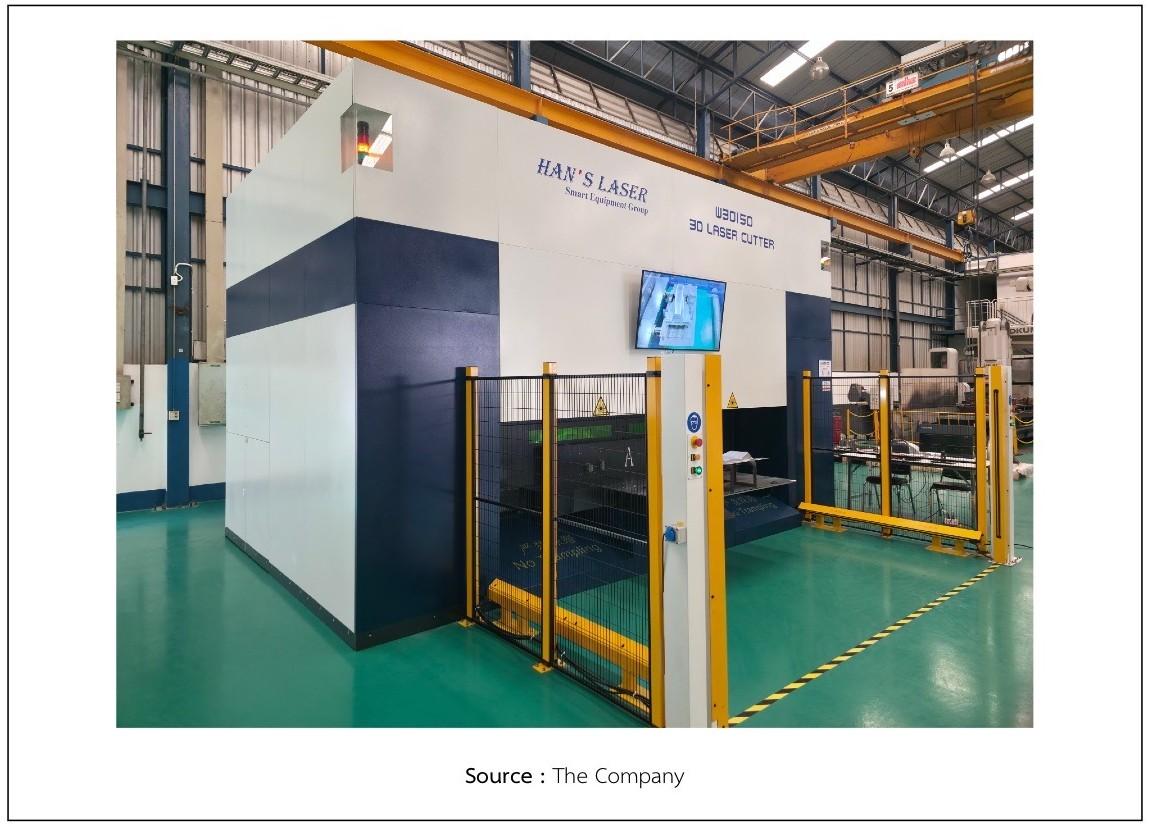
The 3D Laser Cutting Machine simplifies the mold manufacturing process.
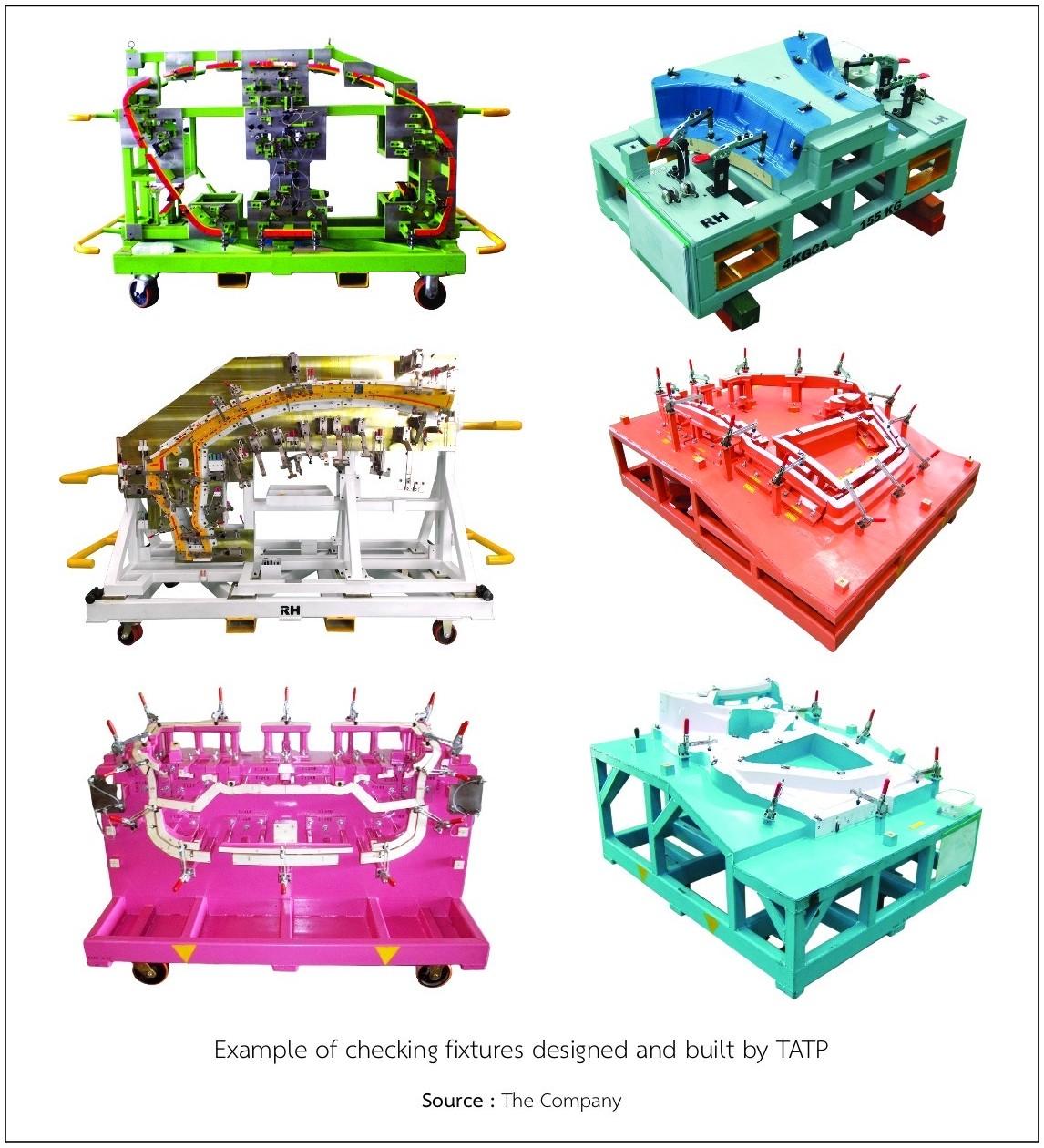
1.2 Checking Fixtures Product quality inspection tools are important equipment in the manufacturing of automotives, which require that the parts of every vehicle meet the same manufacturing standards. Checking fixtures are a type of measuring tool that has a unique characteristic, that is, it is designed to have a shape specifically for inspecting each particular workpiece. Measurements include both single parts and composite parts. The measurement of workpieces on checking fixtures also require the use of other measurement devices, such as a taper gauge, to help read the measured coordinate values, including the trim line and surface inspection to ensure that values correspond to the Check Sheet Inspection standards. From our expertise in the manufacturing of metal dies under the operation of TATP through its team of highly skilled engineers and technicians, the Group has also gained the trust of automotive and parts manufacturers to design and manufacture checking fixtures. This means that we are a Thai manufacturing company that possesses expertise in designing and manufacturing tools for inspecting automotive parts. The Group’s customers who trust the Company to manufacture checking fixtures include Tier 1 OEM suppliers customers and automotive manufacturers (car brands). In addition, completed workpieces will be the property of the customers who hired us to manufacture them and are delivered to our customers’ manufacturing plants. Only a small part of them is kept at the Group's manufacturing plant for use in inspecting the parts that the Group has later manufactures. The work process in designing and manufacturing checking fixtures can be summarized as follows: 1) Preparation and design phase 1.1 TATP receives technical information and details about the characteristics of the workpieces to be checked from the customer. 1.2 Checking fixtures are designed (C/F) using CAD drawing programs. 1.3 Material preparation. 2) Manufacturing process 2.1 CNC milling. 2.2 Assembly and finishing. 3) Checking fixture quality control (C/F) by checking quality according to the customer’s specifications. 4) Delivery. Comparison table of maximum capacity utilization and actual capacity utilization for design and construction of TATP checking fixtures in 2023-2025
Source: The Company Note:
Checking fixtures vary according to the shape of the workpiece and the points to be inspected, ranging from simple to complex and expensive designs. These devices are designed and built to reduce inspection time and increase inspection accuracy.
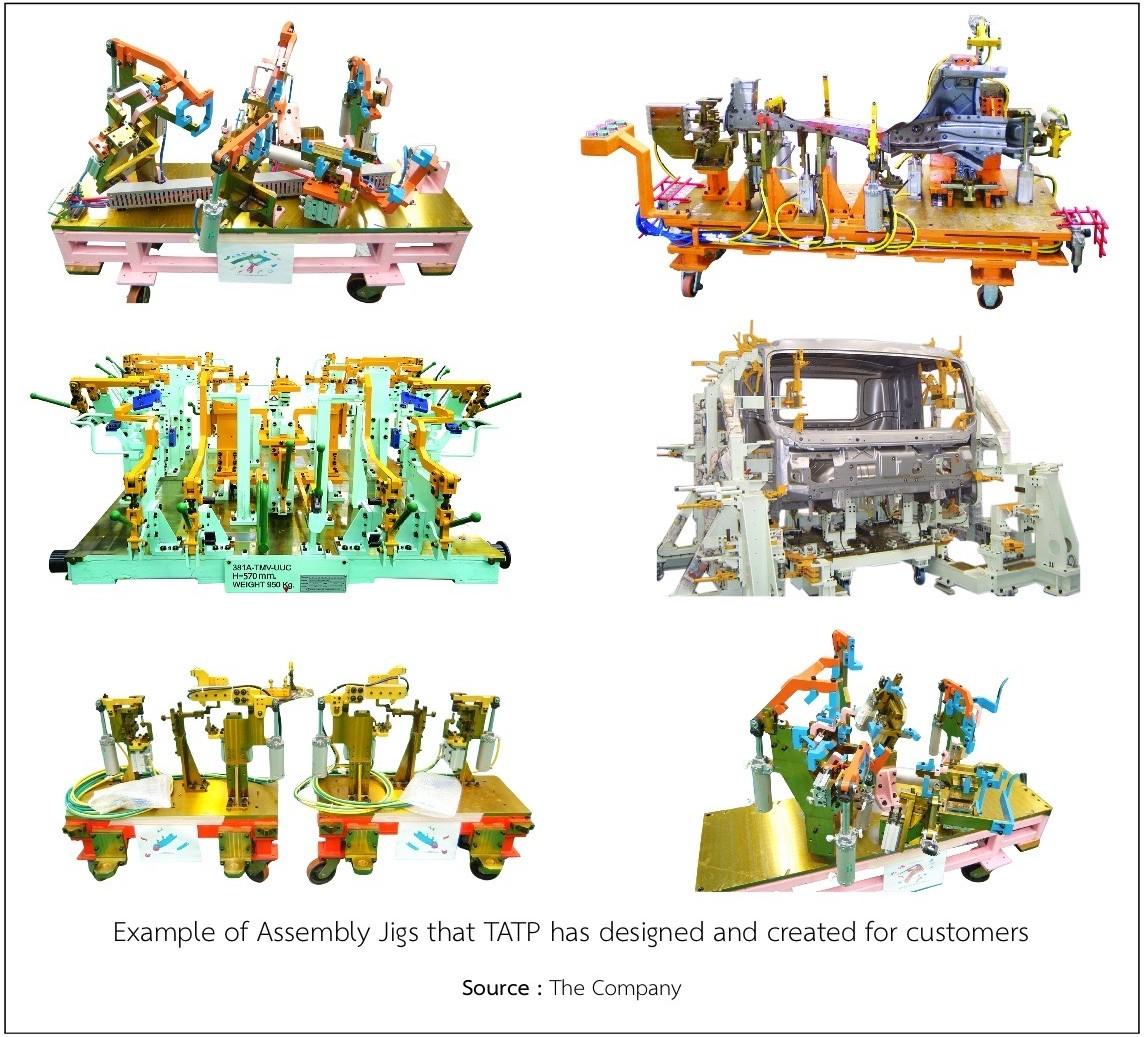
For future plans, in order to support the increasing demand for high-precision checking fixtures resulting from the transition toward electric vehicles (EVs), which are competitive in terms of speed, quality and price, TATP prepares its personnel by continuously enhancing their knowledge and skills, while making additional investment in necessary software and equipment to support faster and higher-precision production. 1.3 Assembly Jigs Assembly jigs are an important part of the automotive manufacturing and assembly process. They are used to hold automotive parts in place in order to weld and assemble them together. Assembly jigs are products that are manufactured according to specific orders for each car model’s production line. In designing and creating assembly jigs, TATP’s engineering team will study the details and technical requirements of the customer to design, model and assemble them by calculating the movement of the equipment based on ergonomic principles while taking into account safety at work before proceeding to manufacture the equipment. Accordingly, the main customers of TATP are car brands and Tier 1 OEM suppliers customers. The manufacturing of assembly jigs is another area of expertise of TATP. Under the operation of TATP, we are recognized for meeting international quality standards. TATP is a Thai company with extensive experience in manufacturing important tools for use in the automotive manufacturing process. The work steps in designing and creating assembly jigs can be summarized as follows: 1) Preparation and design phase 1.1 TATP receives technical information and details about the characteristics of the workpieces to be assembled from the customer. 1.2 Assembly jigs are designed using CAD drawing programs. 1.3 Material preparation. 2) Manufacturing phase 2.1 The structure of the assembly jigs is created (CNC machining). 2.2 Assembly and finishing. 3) Inspection of assembly jigs by testing the assembly of single automotive parts into finished products (component parts) that meet the quality requirements of customers. 4) Delivery by installing and testing the assembly of parts at the customer's factory. Comparison table of maximum production capacity and actual production capacity for the design and manufacturing of assembly jigs by TATP in 2023-2025
Source: The Company Note:
Assembly jigs are tools used in industries that produce workpieces with numerous components, such as the automotive industry. The principle of assembly jigs is to hold multiple workpieces, placing them onto locator pins for assembly, which involves spot welding by applying electric current to firmly join metal sheets at specified points according to the design. This ensures that all assembled workpieces have identical dimensions and meet the same quality standards.
The manufacturing process of the Group's assembly jigs has been certified according to international standards in terms of quality, safety and the environment. The Group has made investments to use modern technology in the design process and various production simulations to assess risks and inspect quality before the actual use of workpieces. This includes increasing the use of industrial robotics or automated systems in production and preparing and developing personnel to enhance their ability to use modern tools to help make production faster and more precise.
| ||||||||||||||||||||||||||||||||||||||||||||||||||||||||||||||||||||||||||||
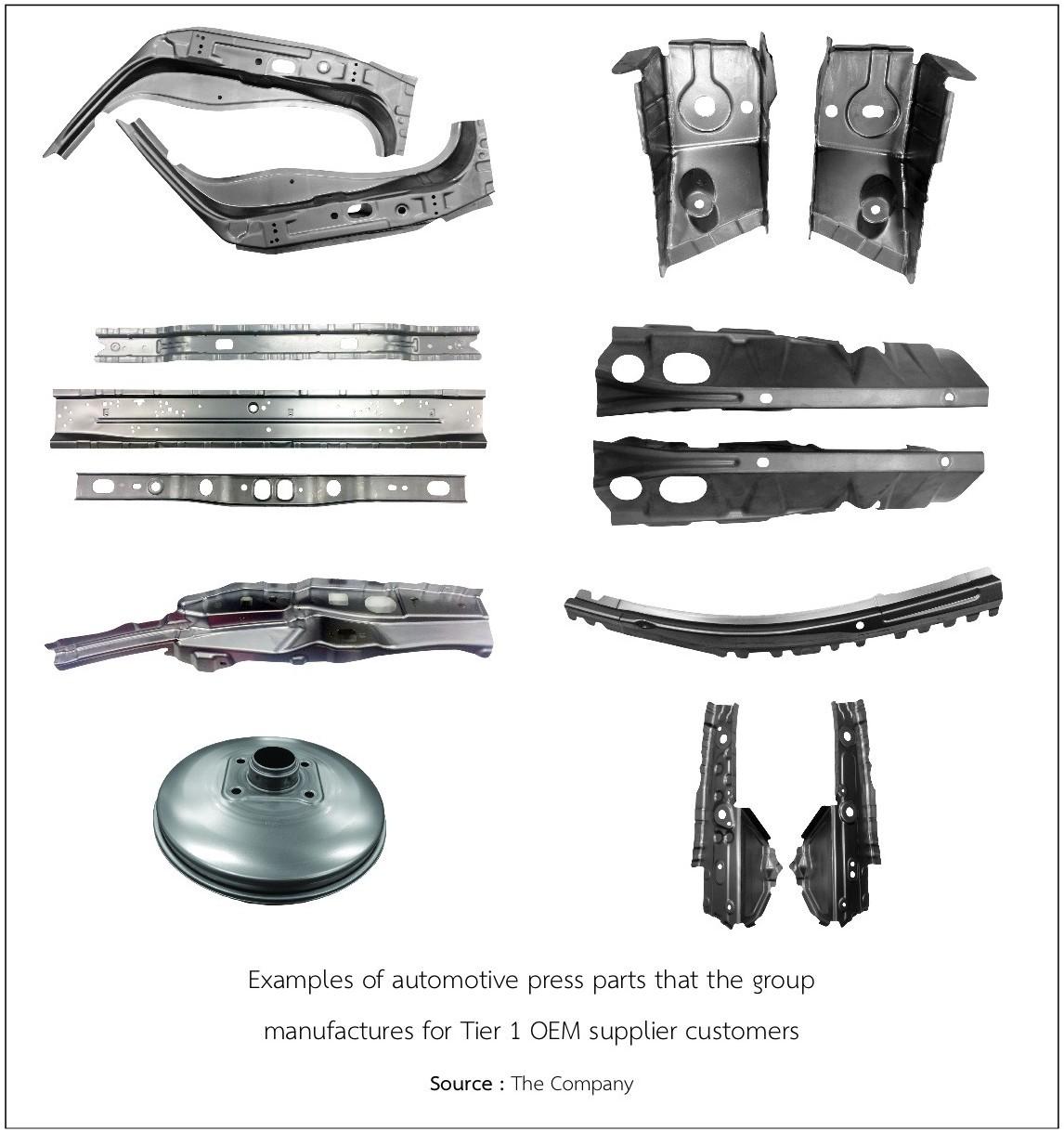
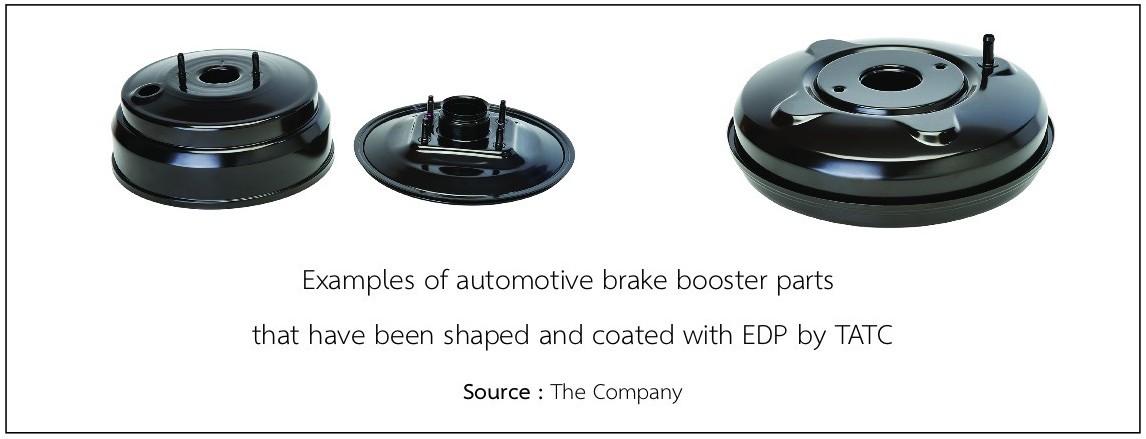
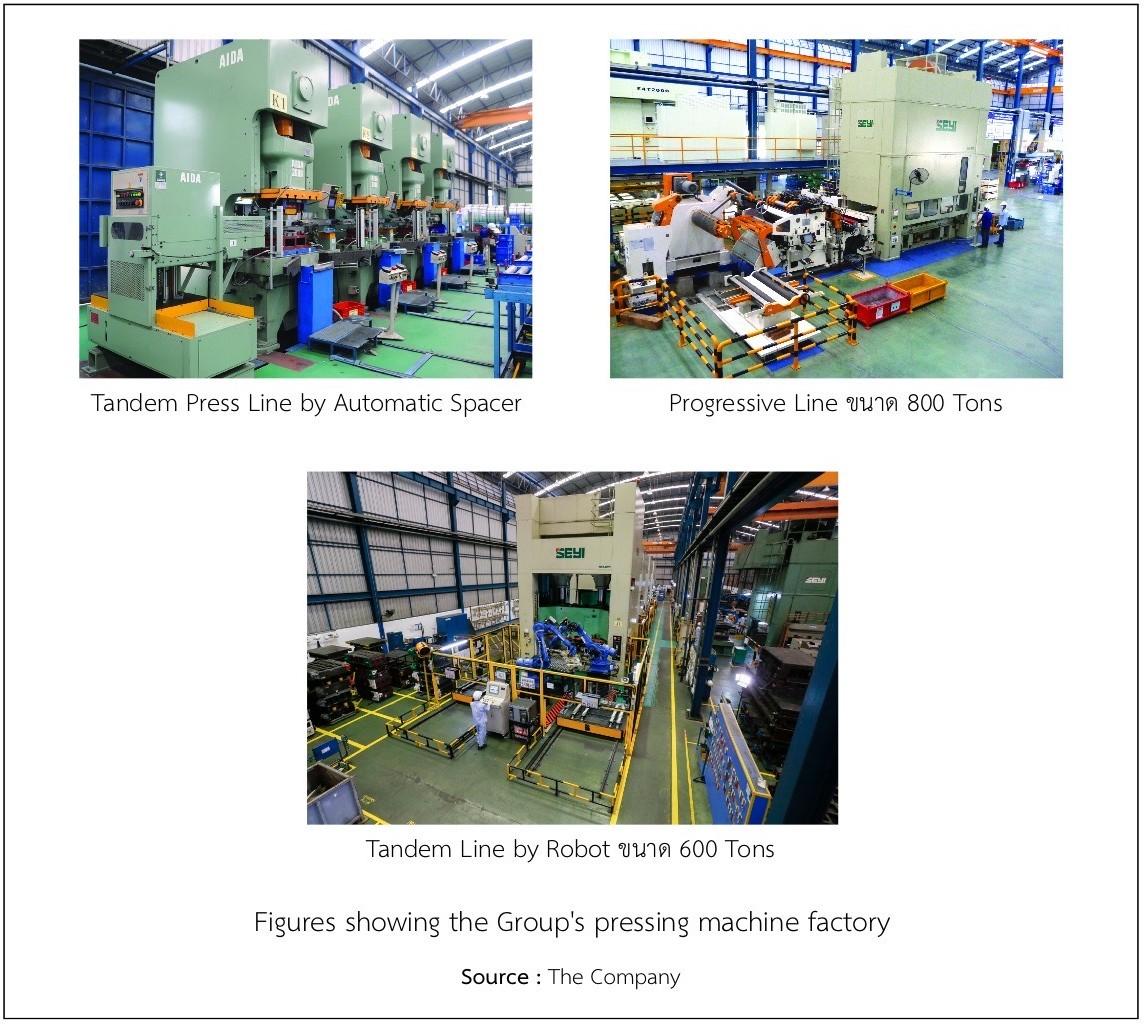
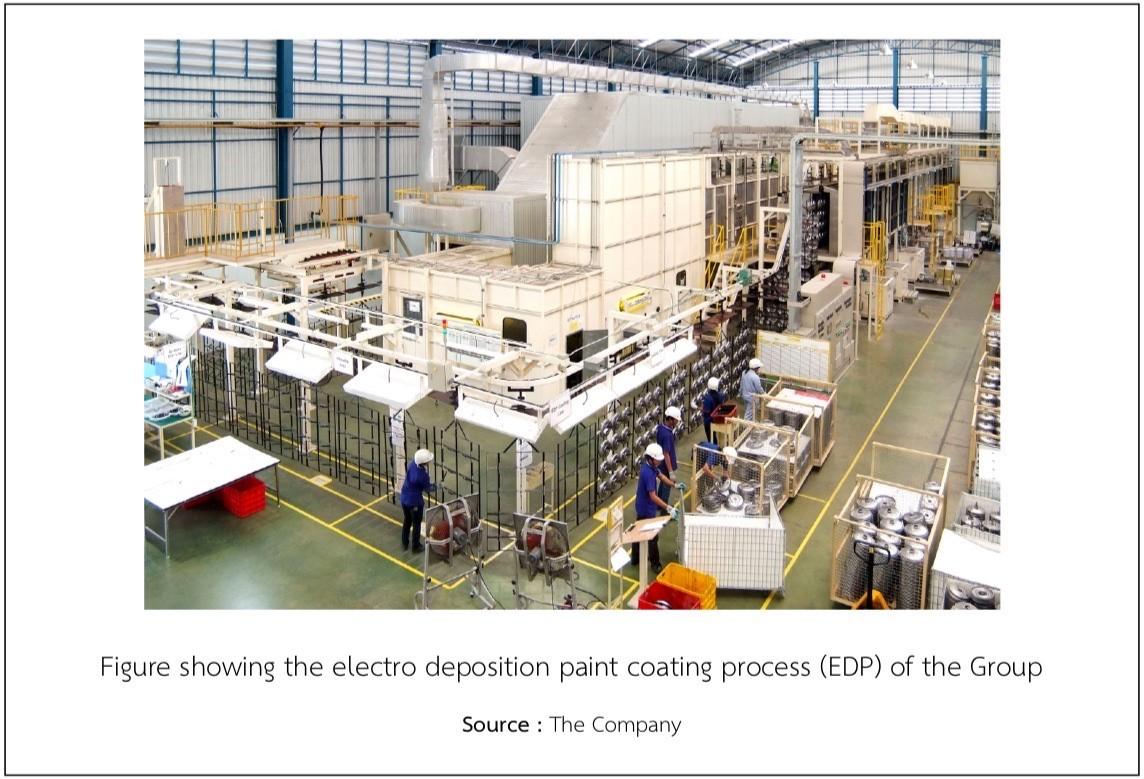
| (2) Automotive Press Parts Manufacturing Business (Automotive Press Parts) | Thai Auto Tools Group has been operating in the automotive parts manufacturing business for a long time since 2004, with a reputation for quality and comprehensive production standards, including welding, parts pressing, appropriate costs, and on-time delivery. As a result, it has gained acceptance from customers, who are OEM Supplier Tier 1 manufacturers for leading Japanese and German brands, leading to continuous business growth. Our production bases are equipped with modern machinery and a production management system that takes into account product quality, cost and on-time delivery. The company located at the strategic areas of Thailand's automotive industry which are Pathum Thani and Chonburi Province under the operation of TAT, TATP, TATC and TATE which are the subsidiary company, TATP, also leading metal die design and manufacturer in Asia. Thus, Thai Auto Tools Group known as continuously gained trust of customers as an Automotive parts for New Models. Thai Auto Tools group knowns as diversify to meet the needs of customers, whether the customers who required high-volumes production and customers who required high-precision parts production. The Group has an efficient production management system and strict quality control at every stage to ensure that the production of parts for every customer is in accordance with plans and objectives to create maximum customer satisfaction. The Group has a production line for pressing parts (press machines) with machine sizes ranging from 200 tons to 2,000 tons, as well as an EDP (Electro Deposition Paint) coating plant, which is a system that uses electricity as a medium to cause a paint absorption reaction in metal surfaces to cause every workpiece to have a consistent and long-lasting color without corrosion or flaking, in addition to having smooth and consistent surfaces and rust resistance. A portion of the company's automotive parts manufacturing customers originate from its metal mold design and manufacturing business. The benefits customers receive include comprehensive services, speed, quality, cost, and confidence derived from the collaboration of TATP which specializes in metal mold manufacturing and can support customers immediately. Some of the Company's customers in the automotive parts manufacturing business come from the metal die design and manufacturing business base. The benefits that customers will receive include comprehensive services, speed, quality, lower cost, and confidence in their collaboration with TATP, which specializes in metal die manufacturing and has the capability to immediately support customers. In the manufacturing of one car, every part is an important and no part can be missing. Therefore, in selecting a parts manufacturer to join a manufacturing project, there is thorough consideration. Tier 1 OEM suppliers manufacturers will select part manufacturers called Tier 2 OEM suppliers that are ready and ensure confidence in production quality standards covering three aspects, namely, product quality, cost, and timely delivery. After the parts from each manufacturer are assembled into the component parts of a car, they are sent to the manufacturing plants of car brands for assembly into a finished car. In the automotive parts manufacturing industry, Thai Auto Tools Group is considered to be Tier 2 supplier that is trusted by Japanese customers consisting of Tier 1 OEM suppliers of the world's leading car brands such as Honda, Toyota and Mitsubishi. We manufacture over 200 different kinds of car parts, such as pickup truck suspension parts (chassis frame components), car body parts, car brake booster parts, and engine parts. The automotive press parts that the Group manufactures using the metal pressing manufacturing techniques (pressing process) has important details and production steps summarized as follows: 1) Feeding sheet metal through a press machine to create shapes and forms according to the design: 1.1 Forming – Sheet metal is shaped as desired according to the die design. 1.2 Trimming/piercing – Sheet metal workpieces are trimmed or pierced according to the desired sizes. 1.3 Restriking – This is the final metal-shaping process to achieve the desired sizes and shapes. 1.4 Separating – Workpieces are separated by cutting into finished pieces. 2) Assembling various subcomponents together to obtain parts according to design specifications. 3) Quality inspection according to requirements before delivering products to Tier 1 OEM suppliers customers to be assembled into automotive parts before the Tier 1 OEM suppliers customers supply the parts to the automotive manufacturing plants of car brands. The Group has its own EDP (Electro Deposition Paint) coating plant that meets international standards under the supervision of TATC. Located at TATC's manufacturing plant in Ban Bueng District, Chonburi Province, it is currently trusted by customers who are world leaders in automotive technology from Germany and Tier 1 OEM suppliers of many leading car brands with production bases in Thailand that export to many countries by being trusted to manufacture and apply paint coating to brake booster caps and oil pans. The EDP coating plant is a system that uses electricity as a medium to react with metal surfaces to ensure that every work piece has consistent color quality in addition to being resistant to corrosion. The Group has a systematic work process and personnel ready to provide services to customers in both sales and after sales. For orders, customers provide us with a forecast of the demand of the products to be ordered throughout the entire production life cycle and commercial distribution of each car model for which the Group will be the parts manufacturer. This includes an estimate of the need for replacement parts during the period after the end of commercial production of each car model. Whenever customers want to order automotive press parts from the Group, the customers will send a purchase order (PO) to the Group by about 1-3 months in advance to allow time to prepare and procure raw materials, as well as plan production and undertake the actual production to successfully deliver products according to the customer's order. The Group takes care of and stores the metal dies to ensure that they remain in good condition (if required by the customer) to be ready for use to support future purchase orders. The three automotive parts manufacturing factories (TAT, TATC and TATE) have efficient production management and strict quality control. The Company has implemented the TPS or Toyota Production System to meet production targets, reduce production waste, and be ready for every production in order to manufacture quality workpieces and meet the target quantities. Accordingly, we have issued the 5 Readiness measures and promote them to be implemented on every occasion, by which it is necessary to ensure that all 5 aspects are fully ready before the commencement of production, namely,
This ensures that every workpiece, every order and every project that is assigned will be successful and impress and satisfy customers, leading to spread by word-of-mouth about our superior quality. The features and ready capabilities of the three automotive parts manufacturing factories can be summarized as follows:
For the group's automotive parts manufacturing business, it is classified as an OEM Supplier Tier 2, primarily producing and distributing automotive parts to car manufacturers (Car Brands) and OEM Supplier Tier 1. Most OEM Supplier Tier 1 companies are automotive parts manufacturers that supply to Car Brand production plants
The group efficiently manages its production plants and systematically handles scrap materials from the stamping process. This not only avoids environmental impact but also generates additional income. Daily, scrap metal remaining from the stamping process of TAT, TATC, and TATE is conveyed via conveyor belts into waiting trucks at the end of the production line to be weighed before being sold to scrap metal dealers. The revenue from the sale of these scrap materials is recorded as part of the group's income. However, the revenue from scrap metal sales may change and fluctuate over time depending on the price offered by buyers, which the group continuously monitors and verifies from buyers on a monthly basis. The value of the remaining scrap metal will be part of the calculation deducted when determining the unit price of automotive parts. The Group's production capacity for Automotive Press Parts From 2023-2025 Comparison table of TAT's capacity utilization in the production of Automotive Press Parts, 2023-2025
Source: The Company Note:
TATE's production capacity comparison table for automotive press parts manufacturing in 2023-2025
Source: The Company Note:
Comparison table of TATC's production capacity in automotive press parts production in 2023-2025
Source: The Company Note:
TATC's production capacity for electroplating EDP parts in 2023-2025
Source: The Company Note:
|

Research & Development
Has R&D Policy (Y/N)
No
R&D Cost — Description
The company invests in advanced manufacturing technology to reduce production steps. We currently invested in 3D 5-axis fiber laser cutting machines to enhance production speed and efficiency.
R&D Cost — Label
Research and development (R&D) expenses over the past 3 years (Million Baht)
R&D Cost — This Year
10.5
R&D Cost — Last Year
0.88
R&D Cost — 2 Years Ago
3.9
Assets Used in the Business
Permanent Assets — Description
(Details of assets used in business operations are provided in Annex 4)
Intangible Assets — Description
(Details of assets used in business operations are provided in Annex 4)
Has Subsidiaries Investment Policy (Y/N)
Yes
Subsidiaries Investment Policy — Description
The Company focuses on investing in subsidiaries and associated companies (if any in the future) that possess growth potential and can generate favorable returns on investment. The Company will prioritize long-term investments, considering the fundamental factors of the target businesses and their significant trends. Furthermore, the Company maintains a policy of investing in a sufficient proportion to enable its participation in the management and determination of business guidelines for these subsidiaries and associated companies, as well as promoting the sustainable growth of the invested entities. Additionally, the Company may invest in other businesses related to the automotive parts manufacturing sector in the future. All such investments must undergo thorough study, analysis, and feasibility assessment, considering business potential and investment risks. These investments must be consistent and appropriate with the Company's business conditions and long-term strategic plan. The approval process for investments must comply with the Notification of the Capital Market Supervisory Board regarding the criteria for significant transactions classified as the acquisition or disposition of assets, and the Notification of the Stock Exchange of Thailand regarding the disclosure of information and operations of listed companies concerning the acquisition or disposition of assets.
Marketing Policy & Competition
Reporting Mode
3117
Marketing Policy (Overall)
1. Competition Policy and Product Distribution of the Company
1.1 Target Customers
For the automotive metal stamping parts (Automotive Press Parts) manufacturing business operated by TAT, TATE, and TATC, the main customers are parts manufacturers who are OEM Supplier Tier 1 of leading Japanese car manufacturers. These customers place orders for products from both the Group and other manufacturers (OEM Supplier Tier 2) to assemble and produce automotive components (Component Parts), which are then supplied to major leading Japanese car manufacturers (Car Brands) with production bases both in Thailand and abroad.
The key reason why customers, who are OEM Supplier Tier 1, trust and choose the Group to produce parts for new car models for both domestic sales and worldwide export, is not only due to its integrated production base, international standards, modern machinery, and qualified personnel, but crucially, its quality policy that prioritizes customer satisfaction and the achievement of customer goals in terms of product quality, cost, and on-time delivery.
The Group's main customers, in addition to OEM Supplier Tier 1 of leading Japanese car manufacturers, also include trusted customers who are OEM Supplier Tier 1 from Germany. These customers rely on the Group for the complete production of vacuum brake booster covers, including EDP (Electro Deposition Paint) coating, for delivery to almost all car manufacturers (Car Brands) in Thailand, as well as for export to other countries.
The long-standing trust from customers since 2013 to produce automotive brake boosters, which are safety-critical components, for almost all car manufacturers' production lines in the country, as well as for export to several countries, clearly demonstrates the Group's production potential and quality under the excellent supervision of TATC. The Group is considered the sole manufacturer in Thailand selected to produce these highly critical components.
With international production quality standards, the Group also has customers who are manufacturers of air conditioning parts and other automotive parts, which helps maintain consistent production capacity. This is particularly useful when there is surplus production capacity after manufacturing and selling products to its main OEM Supplier Tier 1 customers.
For the business of designing and manufacturing tools (Tooling) used in automotive parts production, operated under TATP, the Group's main customers include both direct leading Japanese car manufacturers (Car Brands) and automotive parts manufacturers who are OEM Supplier Tier 1. The Group has also been registered as a vendor (Vendor list) for two leading Chinese car brands.
The Group's management believes that its continuous efforts to maintain production efficiency, control production and operational costs, ensure the quality of parts and services, and uphold business reliability are crucial factors enabling the Group to continuously maintain good long-term business relationships with various customers, as well as increasing opportunities. For the Group to continuously receive orders from various customers, the management also seeks new business opportunities and avenues by continuously developing and learning production and operational techniques, and maintaining good business relationships with various customers. This is considered a crucial part for the Group in pursuing new business opportunities in the automotive parts manufacturing tool business (Tooling) and the production of automotive parts (Press Parts). Furthermore, the Group has set a goal to adjust the production line to Automation System by installing Tandem Line by Robot in order to manage the cost reduction and increase productivity.
1.2 Pricing Policy
The Group establishes a pricing policy to ensure consistent and appropriate implementation across all its entities. The Group's selling prices are determined by adding a margin to the cost. Furthermore, pricing criteria for intercompany transactions within the Group have also been established.
1.3 Distribution Channels
The Group operates businesses in designing and manufacturing tools, and producing metal stamped automotive parts according to the supply chain management system of major automotive parts manufacturers. Therefore, for existing customers where the Group is already on their Vendor Lists, the customers will contact the Group to obtain initial information regarding metal molds or metal stamped automotive parts (Press Parts) for quotation and production capacity assessment.
For new customers, the Group's marketing department will be responsible for contacting car manufacturers (Car Brands) to inquire if there are new supply chain companies (OEM Supplier Tier 1) to apply for inclusion in their Vendor List, in order to present products and services in the future.
Industry & Competition (Overall)
Overview of the automotive industry in Thailand
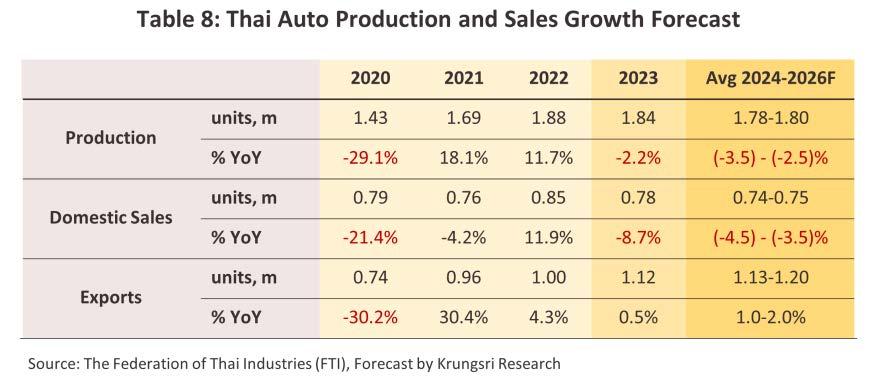
In 2025, the automotive industry continues to face challenges due to the slowing domestic economy and the retaliatory tariff measures between the United States and China, which have affected many countries in Asia. Thailand is subject to a 19% import tariff on goods. For the automotive industry, the U.S. has increased tariffs on cars and automotive parts from all countries to 25%, which is one of the factors that the Federation of Thai Industries has reduced.
The remaining cars production is 1,450,000 units, and this is an adjustment from the export volume of 50,000 units, particularly cars from Japan. According to Krung Thai Bank's analysis, Japan is among the top 3 countries exporting cars to the U.S. This import tariff increase could impact the Thai automotive parts industry in many sectors, due to limited profit margins and pressure from rising production costs. Despite challenges from external factors, the domestic automotive industry is expected to grow from the electric vehicle (EV) sector, which is in line with the forecast from Krungsri Bank's analysis during 2567-2569 that the automotive industry is still growing. In 2025, electric vehicle sales will increase due to the EV3.0 measure requiring compensatory production. In 2026, the automotive industry is expected to expand due to the following factors:
Easing of the global chip shortage problem due to accelerated investment in chip manufacturing plants by leading companies worldwide in the past period.
Measures to restructure Thailand's automotive industry, including measures to reduce excise tax on automobiles. HEV to support car manufacturers developing HEV technology, mostly existing manufacturers, to invest further in expanding HEV production capacity during 2024-2027.
Car production BEV during 2024-2025 and 2026-2027 under EV 3.0 and 3.5 support measures, respectively, to compensate for previous domestic car imports. It is expected that from 2025 onwards, new manufacturers will have an electric vehicle production capacity of approximately 600,000 units per year.
Overview of the Thai Automotive Parts export
The automotive industry remains one of the country's key industries and has been continuously supported by the government. Measures are being implemented to support the Thai automotive industry. In the year 2025, significant measures for export promotion of the automotive industry were as follows.
Board of Investment: BOI with measures to promote the use of domestic production components. Local Content Requirements: LCR has approved an investment promotion budget of 96,000 million baht to upgrade Thailand's supply chain to compete on the global stage.
Intensify the consideration of production processes that are crucial to the project seeking promotion, to prevent rights abuse and increase the value from production in Thailand.
Support and care for internal combustion vehicle manufacturers and parts. Although the volume of internal combustion vehicle exports continues to shrink, for pickup trucks, exports remain popular in the market.
The automotive parts market is divided into 2 major markets: OEM (Original Equipment Manufacturers) and REM (Replacement Equipment Manufacturers). The OEM market is a market in which manufacturers manufacture products according to the orders of buyers, while the REM market is a market that manufactures products and equipment to replace damaged ones, which makes it more oriented toward car users than primarily car manufacturers.
Currently, there are more than 2,200 manufacturers in the automotive parts industry in Thailand, consisting of the following:
1.Tier 1 OEM suppliers are manufacturers of high-quality automotive parts according to the standards set by leading car manufacturers for use in car assembly plants (OEM market) and some of their parts are also sold in the replacement parts market (REM market). There are currently 720 manufacturers in this category, divided into multinational companies by 47% and joint ventures between Thai and foreign companies by 30% and Thai operators by 23%. They make up 54% of all operators, of which 28% are automotive parts manufacturers and 18% are manufacturers of both parts categories.
2.Tier 2 OEM suppliers and Tier 3 OEM suppliers are mostly Thai-capitalized SMEs that invest in the research and development of manufacturing technology at lower levels than Tier 1 OEM suppliers. Therefore, they are at a disadvantage in terms of directly accessing the automotive manufacturing and assembly market. As a result, this group of automotive parts manufacturers are only suppliers of raw materials and/or manufacturers of assembly parts for Tier 1 OEM suppliers and/or manufacturers of replacement automotive parts or spare parts (REM market). Currently, the REM market has more than 1,500 operators, and they are divided into 2 main types of automotive parts manufacturing as follows:
1.Genuine parts are parts or components that automotive manufacturers or Tier 1 OEM suppliers hire out their manufacture according to set standards.
2.Non-genuine parts are parts that are manufactured without control of manufacturing standards by the automotive manufacturer. (Parts of this type are typically of a lower quality than genuine parts.) These parts target the lower-end market because they are cheaper. The competition among entrepreneurs classified as Tier 2 OEM suppliers and Tier 3 OEM suppliers focus on product prices, while product quality and standards are still at a level that customers can accept.
Future direction of the automotive parts industry
The domestic car market is expected to begin to recover in 2025-2026, supported by demand from business activities and increased investment, while the tourism sector is expected to continue growing and return to pre-COVID levels in 2025, which will help boost demand for passenger cars for travel, as well as accelerated investment in infrastructure that will boost orders for commercial vehicles for transportation, and the entry into the La Nina phenomenon. The increase in rainfall is conducive to agricultural productivity, which will help increase demand for pickup trucks to carry agricultural produce. There are also other supporting factors such as;
The strategy of sales promotion and price wars intensified in both the electric vehicle segment (along with the development of new models of passenger combustion vehicles to compete with electric vehicles)
The trend of decreasing the number of cars being seized has led to an increase in used car prices, providing an opportunity for some consumers to decide to buy a new car after selling their existing car more often.
The trend of continuous expansion of the domestic electric vehicle market is driven by the EV 3.5 measure, which stimulates purchasing power, as well as the development of electric vehicle models and performance.
The export direction of the automotive industry is still facing this loud factor.
The uncertainty from the US tariff measures affecting global trade
The slowdown in the economies of trading partners affects purchasing power and car sales.
Agree to tighten carbon emission requirements.
The discontinuation of some car models to shift production lines to new models
A situation of geopolitical conflict 6. The competition from cars within trading partners' countries
Procurement of Products & Services
Reporting Mode
3117
Procurement (Overall)
1.Procurement and preparation of Engineers and technical personnel
Technical labor and engineers are considered a crucial part of the Group's production, as the design and manufacturing processes are vital to the operation of the automotive parts manufacturing business (Press Parts), as well as the business of designing and building metal molds and fixtures used in automotive parts production (Tooling). This requires the expertise, skills, experience, and craftsmanship of engineers and technical personnel who must possess a thorough understanding of design and manufacturing processes, be proficient in manufacturing techniques and machine tools, and have excellent knowledge of design software (Drawing).
The Group places importance on personnel development alongside the modernization and high-efficiency of production techniques and processes. It promotes a work culture known as "Training for the Trainer," which ensures that new employees quickly acquire knowledge, develop skills, and gain expertise to support various tasks. The Group instills and encourages all employees to foster unity, understand teamwork, think and act proactively, and learn and perform their duties with responsibility towards their roles, society, and the environment. In the past, the Group has sent some technical staff and engineers for training and to enhance their knowledge and experience in production at a factory in Japan, operated by an affiliate of one of the Group's key customers. Furthermore, the Group has collaborated with external educational institutions offering engineering programs to conduct research in the design and construction of machine tools (Tooling) used in automotive parts production, as well as other related and beneficial areas for automotive parts production (Press Parts). The objective is to apply the research findings technically and commercially, thereby responding to government policies aimed at enhancing Thailand's long-term competitiveness.
2. Procurement of essential production machinery and tools
For the production of automotive parts, the design and construction of metal molds, and fixtures used in automotive parts production (Tooling), the Group procures medium and large-scale production machinery, as well as other supporting tools, from manufacturers and distributors both in Thailand and abroad, such as Japan and Germany. The objective is to increase production capacity and improve the efficiency of production processes. Key factors considered when deciding which supplier the Group will order machinery and production tools from include the expertise and specialization of each supplier for each type of machinery, the quoted price, the lead time for procurement and delivery of machinery and equipment, warranty conditions, and after-sales services, as well as the past business relationship between the Group and the supplier.
Raw Material Acquisition (Overall)
Procurement of Main Raw Materials for Production
For the automotive parts manufacturing business, important main raw materials include high-quality and highly durable steel coils and steel sheets. The Group procures these through manufacturers and distributors in accordance with the customer company's specifications, including type, properties, specific characteristics, and origin, to ensure that the quality of the main raw materials for production meets standards and requirements. Customers who order automotive parts (Press Parts) from the Group play a crucial role and have the authority to consider and decide on the procurement of main raw materials used in the parts manufacturing process. They require the Group to participate in the Central Purchase System (CPS), which is a common practice in the automotive parts manufacturing industry. The Central Purchase System (CPS) lists main raw material suppliers that Car Brands and OEM Tier 1 Suppliers deem capable of producing high-quality and standard steel coils and steel sheets for manufacturing automotive parts (Press Parts) that meet the specifications of the ordering customers. When a customer requires the Group to produce and deliver automotive parts for the customer company's production process, the customer will instruct the Group to procure and order main raw materials from the specific raw material supplier designated by the customer. These suppliers of main raw materials, such as steel coils and steel sheets, will be on the list of the Central Purchase System and the customer's Approved Vendor List. The Group, the customer, and the main raw material suppliers will jointly consider and agree upon the lead time, quantity, quality, characteristics, and price of the main raw materials to be used in the production process. With this CPS purchasing system, the risks associated with the quality, price, and shortage of main raw materials such as steel coils and steel sheets used in the production of automotive parts (Press Parts) that the Group might face in its business operations are reduced.
For the business of designing and manufacturing metal molds, and jigs and fixtures (Tooling) used in automotive parts production, the main raw material for production is high-quality and highly durable cast iron. For the procurement of this type of steel raw material for this business, the Group does not procure raw materials through the CPS system. The Group can procure cast iron from manufacturers and distributors of raw materials that the Group deems appropriate. In determining which supplier the Group will purchase cast iron from, the Group will consider relevant factors such as the quantity and characteristics of the desired products, the price offered by the supplier, the lead time for procurement and delivery of raw materials to the Group, as well as other important commercial terms from the iron foundry.
For TATC, which has an EDP coating process, the important raw materials used in the process include high-quality and highly durable paint. TATC procures these from a leading domestic manufacturer, in accordance with customer requirements and with the approval of the Group as well.
Distributors (Overall)
N/A
Production Capacity (Overall)
| Item | Unit | Unit (if Other) | Used | Capacity |
|---|---|---|---|---|
| Thai Auto Tools and Die Public Company Limited | Others | Stroke | 53.65 | 47,899,451 |
| Thai Auto Tools (Pathum Thani) Company Limited | Piece | 98.75 | 790 | |
| Thai Auto Tools (Chonburi) Co., Ltd. | Others | Stroke | 75 | 15,345,340 |
| Thai Auto Tools (Eastern) Co., Ltd. | Others | Stroke | 70.32 | 12,730,257 |
Domestic/Overseas Purchase Proportion (Overall)
| Raw Material | Source Country | Value |
|---|---|---|
| Steel | Thailand | 0 |
Projects Under Construction
Has Projects Under Construction (Y/N)
No
Debentures & Bills of Exchange
Has Debentures (Y/N)
No
Convertible Securities
Has Convertible Securities (Y/N)
No